Due to an increase in package theft through USPS, we will no longer offer local shipping services. You can still place an order for pick-up online or by calling us at each location. We apologize for the inconvenience!
With a little education on how to read the certificates of analysis, you can be an expert CBD product consumer and know how to tell which products are worth trying!
Below we will show you our COAs, how to read them, and give tips on what to look for from anyone selling cannabinoid-infused products.
State-Required Cannabinoid Testing
For compliance with the hemp farming pilot programs adopted by the NCDA as well as most other states across the U.S., farmers are required by law to have these first two COAs completed at specified times. Since Delta-9 Analytical was the NCDA contracted hemp testing lab and USDA licensed as well, we are currently using them for all our 3rd party lab testing.
First COA
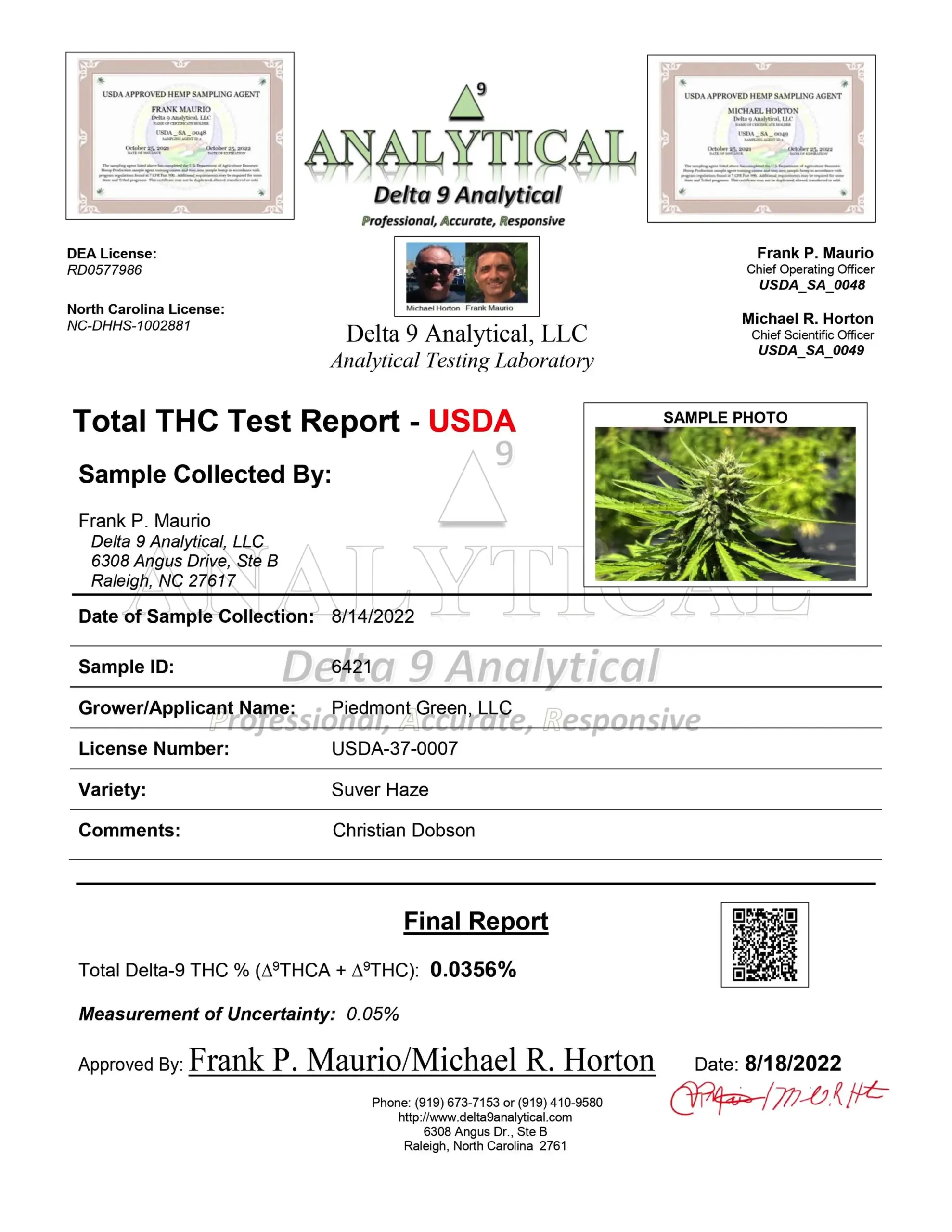
For this first COA, hemp farmers are required to notify the NCDA when their plants transition into the flowering stage, meaning when the plants start producing the bud structure that produces cannabinoids like CBD & THC. The NCDA sends out an agent to take trimmings from the top buds of our plants and collect them for 3rd party lab testing. The NCDA contracts out this service to an ISO & DEA certified analytical testing lab called Delta-9 Analytical. They test the buds to ensure that the THC content is at or below the Federal legal limit of .3% and so long as it is, the crop is approved to harvest.
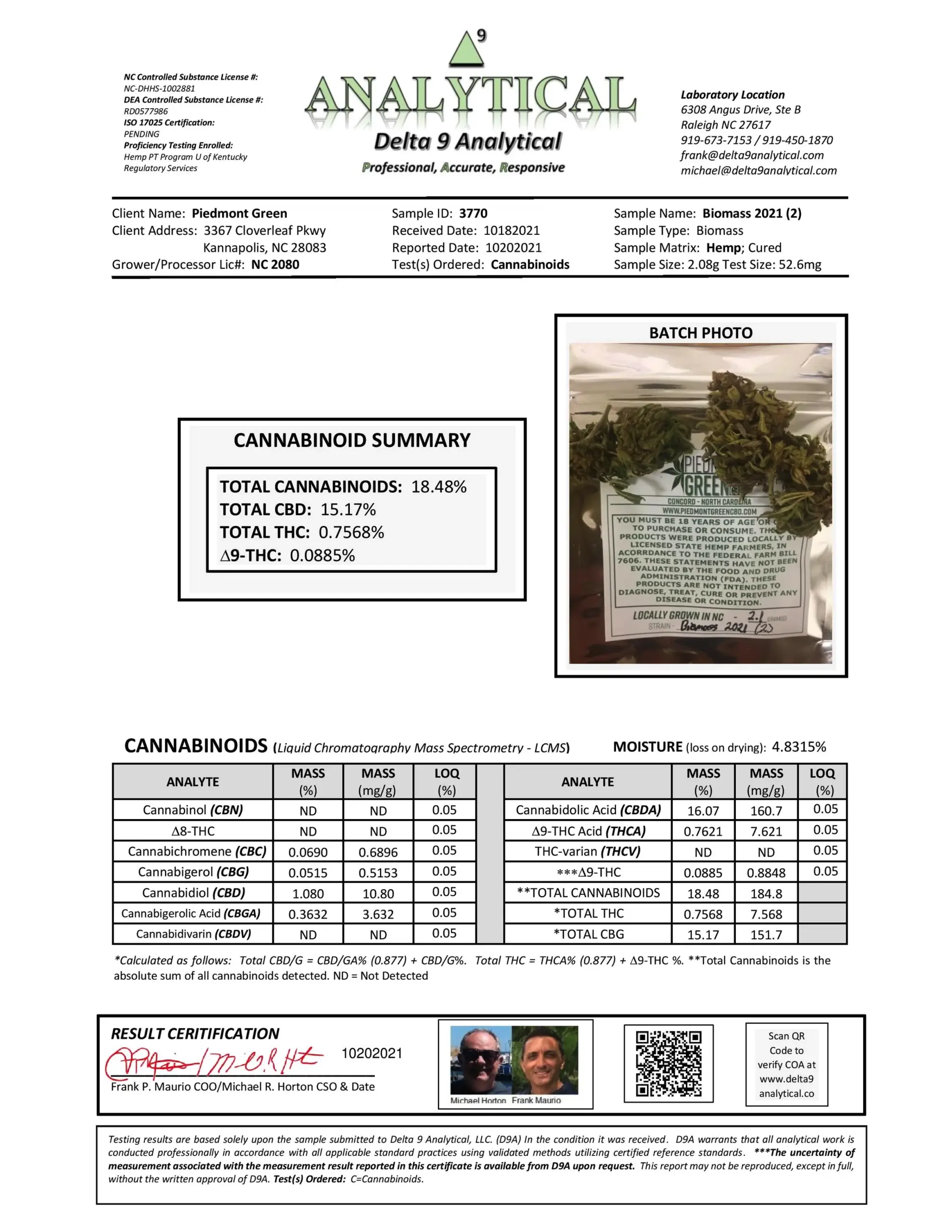
The second state required cannabinoid test is to be conducted on a hemp farmer's flower post-harvest. This is required to be done before the product is either sold or processed into CBD products. So long as the Delta-9 THC level is at or below .3%, the harvest is approved to take to market or be processed for finished CBD goods. As you can see in the COA to the right, our 2020 harvest tested out at .06% Delta-9 THC, well below the Federal legal limit that defines hemp.
2021 Biomass 2 page 001 1645139255 scaled
How to Identify a Fraudulent COA
Always be sure to look for company information on the COA. On the COA to the right you can clearly see in the top right corner Piedmont Green company details. Many CBD companies have been posting COAs on their website or linking through QR codes to COAs that show no business information whatsoever. This means that they are using a "shared" COA and there is no possible way of knowing whether the product you are using is the same product tested in the COA. Avoid any company that does not have their business info on their COAs.
Full-Spectrum CBD Distillate
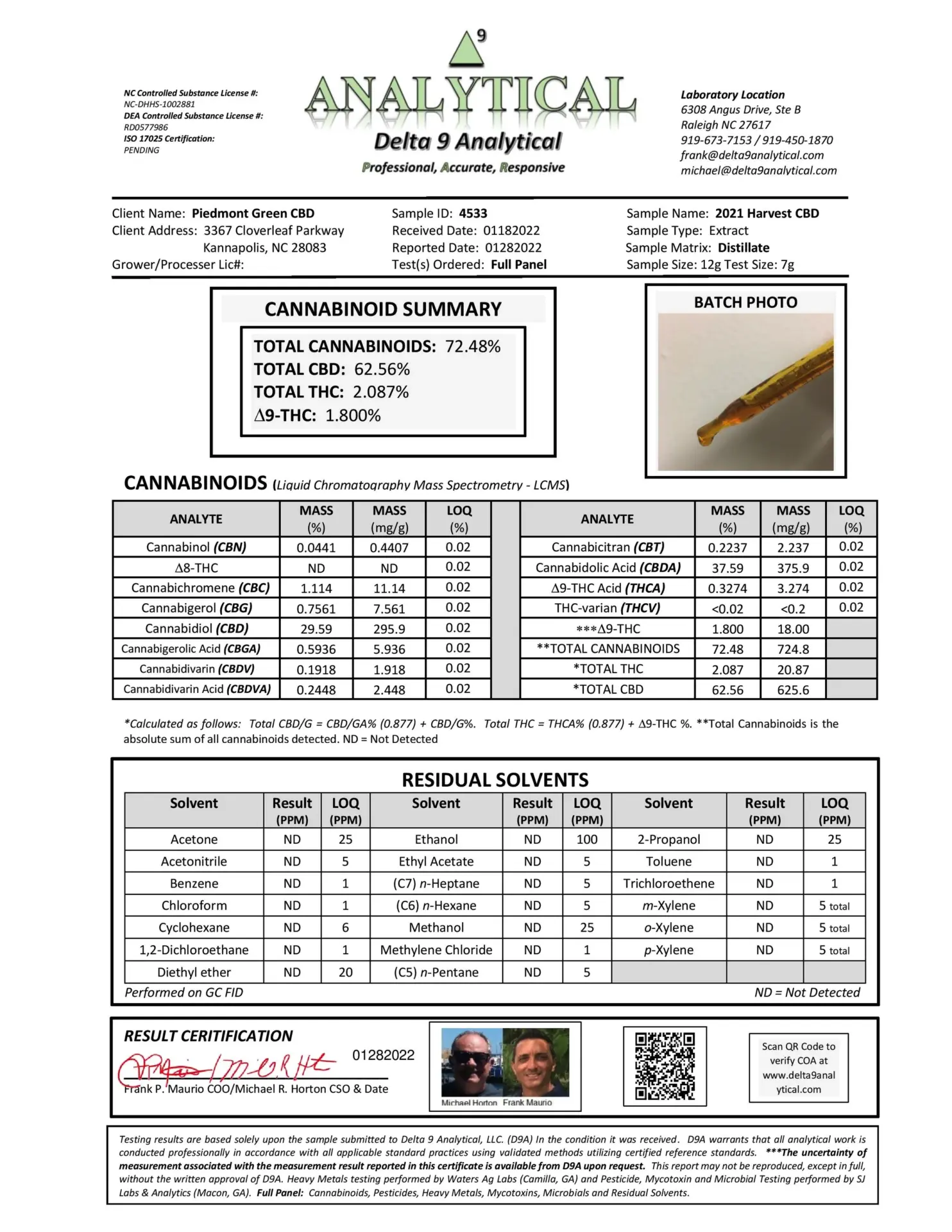
Post-Processing Full Panel COA
At Piedmont Green Dispensary, we firmly believe that full panel COAs for CBD distillate are vital for the health of our clients as well as the future of the cannabis industry in North Carolina!
Full panel COAs contain all the testing required of fully regulated legal cannabis states such as California, Colorado, & Oregon.
Heavy Metals, Microbials, Mycotoxins
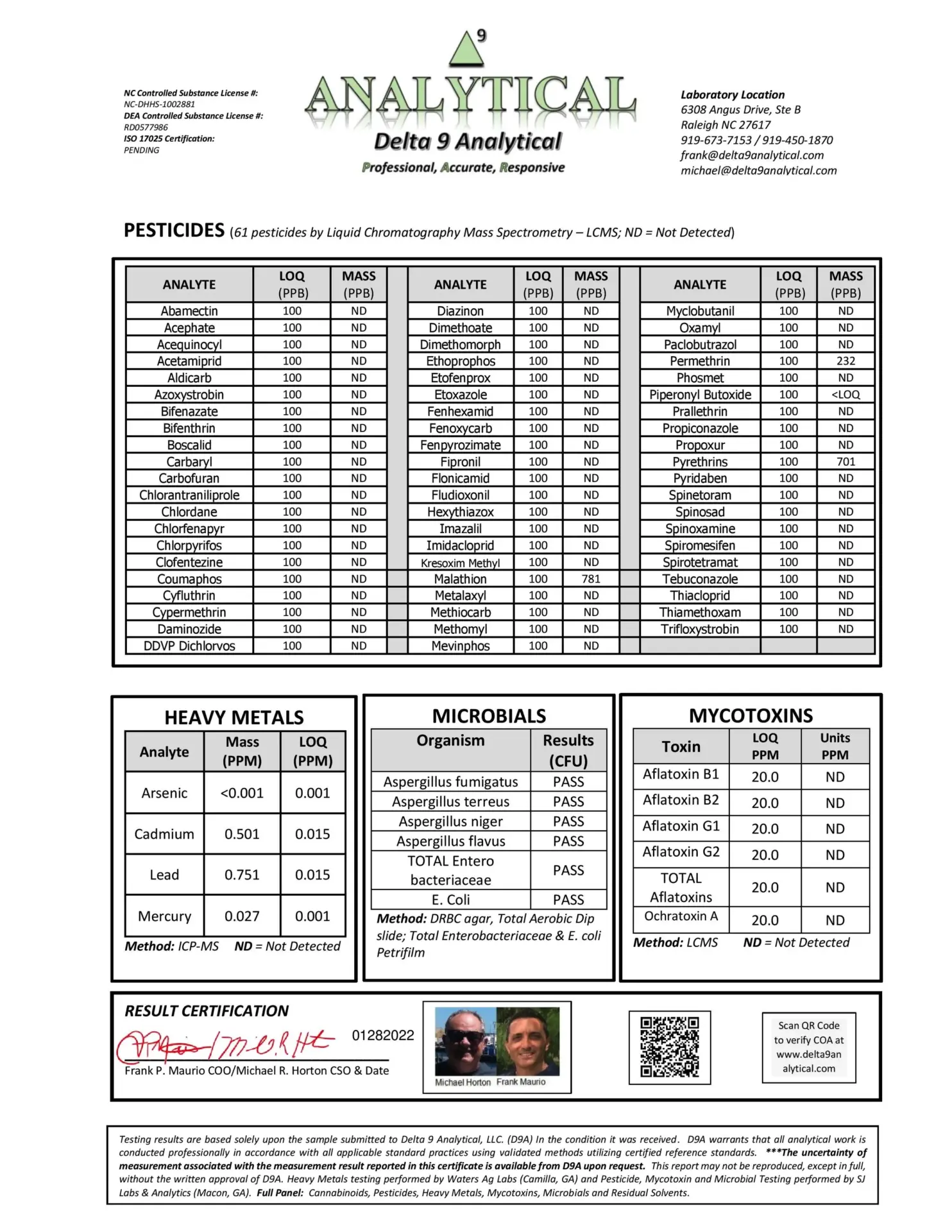
Hemp has an uncanny ability to absorb whatever is in the soil it is grown in. Heavy metals, microbials, and mycotoxins (fungus) appear quite frequently, and it is imperative that CBD companies test their distillate for these substances. As you can see on our full panel, our distillate is clean & clear!
Pesticides
All hemp farmers know that the biggest struggle is pest damage. At Piedmont Green Dispensary, we use all organic practices on our farm. Our only pest management is done using natural predators and OMRI listed insecticides.
Although this is the case, we ended up testing out with VERY low levels of 3 pesticides. The COA shows parts per billion just over 300 at the highest. LOQ is the lowest possible level that is detectable and that is at 100 PPB, making this near trace levels. Also, California limits the following pesticides that showed up in our full panel as follows:
Bifenthrin – CA limit of 500 ppb
Spirotetramat – CA limit of 13,000 ppb
Thiamethoxam – CA limit of 4,500 ppb
According to industry standards, our distillate tested out to be free of pesticides.
Residual Solvents
At Piedmont Green Dispensary we utilize a cryo-ethanol extraction process to produce our Full-Spectrum CBD distillate. Cryo-ethanol extraction is the process of soaking hemp flower in super cooled ethanol that pulls the cannabinoids out of the plant matter. Then the CBD free plant matter is filtered and the CBD rich ethanol is put in a rotary evaporator. This pulls out the ethanol and leaves you with a thick, dark CBD oil called Crude CBD Oil. This is then filtered and distilled into full-spectrum CBD distillate. As you can see in our Full Panel COA, our distillate tested out as ND on all solvents meaning Non-Detectable.
Cannabinoid Content
In CBD distillate, the Delta-9 THC level is not limited by the federal nor state government. This is because CBD distillate is the ingredient used to infuse CBD into a support oil and if need be, into another product entirely. It is then the responsibility of the CBD product manufacturer to utilize a 3rd party analytics lab to ensure that the Delta-9 THC level in the finished, labeled CBD product is at or below .3%.
By entering this website you agree that you are at least 21 years of age.
Yes
pesticide, heavy metals, terpene, cannabinoid, laboratory, contamination, plant, north carolina, drug test, marketing, controlled substances act, patient, food and drug administration, license, regulation, controlled substance, multiple sclerosis, fee, north carolina department of health and human services, united states department of agriculture, hiv, epilepsy, drug enforcement administration, psilocybin, terminal illness, manufacturing, illinois, utah, colorado, skip to content, north carolina medical, compassionate care act, medical, testing labs, minnesota, missouri, nebraska, maryland, real estate, oregon, disease, toxicology, substance abuse, regulatory compliance, law, drug, expert witness, legal, lab management, health, pathology, information, quality assurance, solvent, technology, water, potency, pain, human resources, pain management, safety, expert, software, cherokee, emergency, workplace drug testing, lab, labs, testing process, management, knowledge, product testing, pricing, audit, consultant, mycotoxin, certification, policy, reputation
north carolina cannabis testing license, lab testing for hemp cbd, cbd laboratory testing, north carolina cannabis testing consultant, cbd distillate lab tested us legal, cbd distillate coa, cbd distillate lab tested us market, cbd distillate lab tested california, cbd distillate third party tested us legal, cbd companies that provide certificates of analysis coa, cbd distillate testing lab, cbd companies that provide certificates of analysis
Understanding Certificates of Analysis (COAs)
Certificates of Analysis (COAs) serve as vital documentation that verifies the quality and safety of CBD products. These certificates are generated by independent laboratories and provide detailed information about the cannabinoid profile, potency, and the presence of any contaminants. Consumers should familiarize themselves with how to read these documents to ensure they are purchasing safe and compliant products.
Each COA includes crucial data such as the levels of cannabinoids like CBD and THC, as well as tests for heavy metals, pesticides, and microbial content. Understanding COAs enables consumers to make informed decisions and ensures they are aware of the product's compliance with legal standards. It is essential to look for COAs that are current and from reputable labs to ensure the accuracy of the information provided.
The Importance of Third-Party Testing
Third-party testing is essential in the CBD industry as it provides an unbiased assessment of product quality. By having products tested by independent laboratories, manufacturers can validate the claims made on their labels, ensuring that consumers receive exactly what they are paying for. This transparency builds trust and accountability within the industry.
Third-party testing not only confirms the potency of cannabinoids but also screens for harmful substances such as pesticides, heavy metals, and residual solvents. Consumers should prioritize products that have undergone rigorous third-party testing, as this practice helps mitigate risks associated with unregulated or subpar products. It is a key factor in maintaining the integrity of the CBD market.
How to Read a COA
Reading a Certificate of Analysis (COA) can seem daunting, but understanding its components is crucial for assessing product quality. Key sections of a COA include the cannabinoid profile, which details the percentages of various cannabinoids present, and the test results for contaminants. Familiarizing yourself with these sections can empower you as a consumer.
Common Misconceptions About COAs
There are several misconceptions surrounding Certificates of Analysis (COAs) that can lead to confusion among consumers. One common myth is that all COAs are created equal; however, the credibility of a COA largely depends on the reputation of the testing laboratory and the methods used. It is crucial to understand that not all labs follow the same standards.
Another misconception is that a COA guarantees the absence of contaminants. While a COA provides valuable information about the tested product, it is essential to recognize that it only reflects the results of a specific batch. Consumers should look for products with consistent testing and transparency over time to ensure ongoing safety and quality. Being informed about these misconceptions helps consumers navigate the CBD market more effectively.